Short version. Fleetbase is an AGPL-3.0 logistics suite — orders, dispatch, routing, a driver app, invoicing — written in PHP and Ember. Routly is AGPL-3.0 fleet telemetry: trips, fuel, driver scoring, and reports a provider sends to customers under their own logo. If you move parcels, Fleetbase or Onfleet. If you watch vehicles, Routly. If you only need dots on a map, Traccar.
If you have been searching for self-hosted fleet software you have met Fleetbase. Same licence as us, same self-hostable premise, same objection to per-vehicle fees. They are a serious project and this is not a hit piece. The two answer different questions, and knowing which question is yours saves a month.
Fleetbase moves quickly — v0.7.68 shipped on 5 October 2026 — so every claim about it below links to the source we checked, as of the date at the top of this page.
Fleetbase and Routly, one paragraph each
Fleetbase is a logistics operations suite. Fleet-Ops covers orders, dispatch, routing, drivers and maintenance; Storefront adds commerce; Ledger does invoicing and payments; Pallet is warehousing; Navigator is the driver app, and there is a customer portal on top — all in one AGPL-3.0 repository. If the thing you run is deliveries, it is built for you.
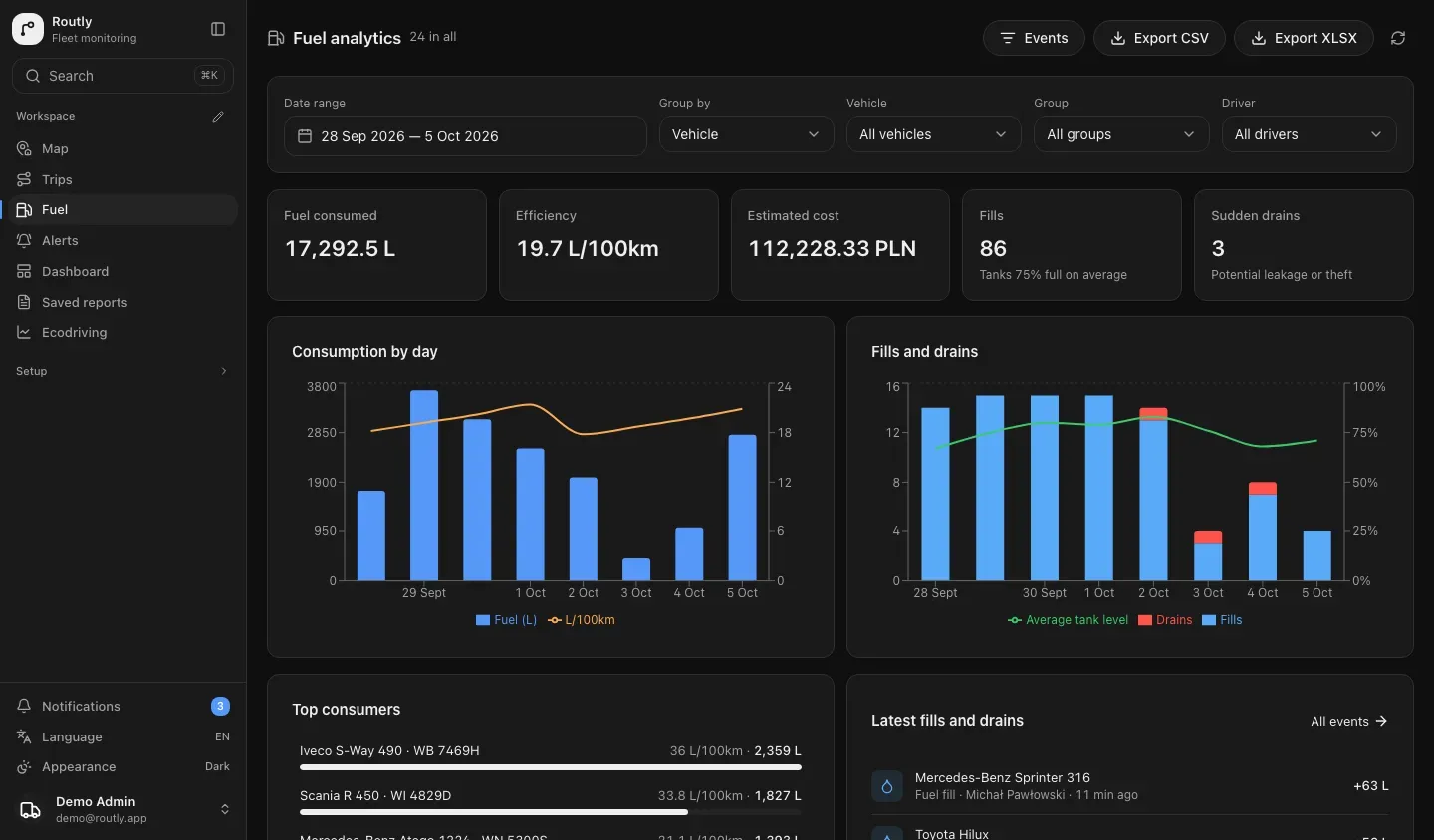
Routly is fleet telemetry and the commercial layer on it. Where the vehicles are, what trips they made, what fuel they burned, who drove how, and reports that go to a customer with that customer’s logo on them. No order management, no dispatch, no routing.
The question that separates them: are you moving parcels, or are you watching vehicles?
Feature comparison
| Fleetbase | Routly | |
|---|---|---|
| Centre of gravity | Orders and dispatch | Positions and what they imply |
| Licence | AGPL-3.0, or commercial | AGPL-3.0, or commercial |
| Stack | PHP (Laravel), Ember.js, MySQL | TypeScript (Fastify, React), Postgres, optional ClickHouse |
| Orders and dispatch | Yes | No |
| Route optimisation | Yes | No |
| Invoicing and payments | Yes, in Ledger | No |
| Driver app | Navigator, for doing the job | Mobile app, for seeing the fleet |
| Live map and geofences | Yes | Yes |
| Telematics connectors | Flespi, Geotab, Samsara, AFAQY, Safee | Flespi, Traccar, any JSON webhook |
| Fuel | Fuel reports and fuel-card transactions | Drain and fill detection from the tank sensor |
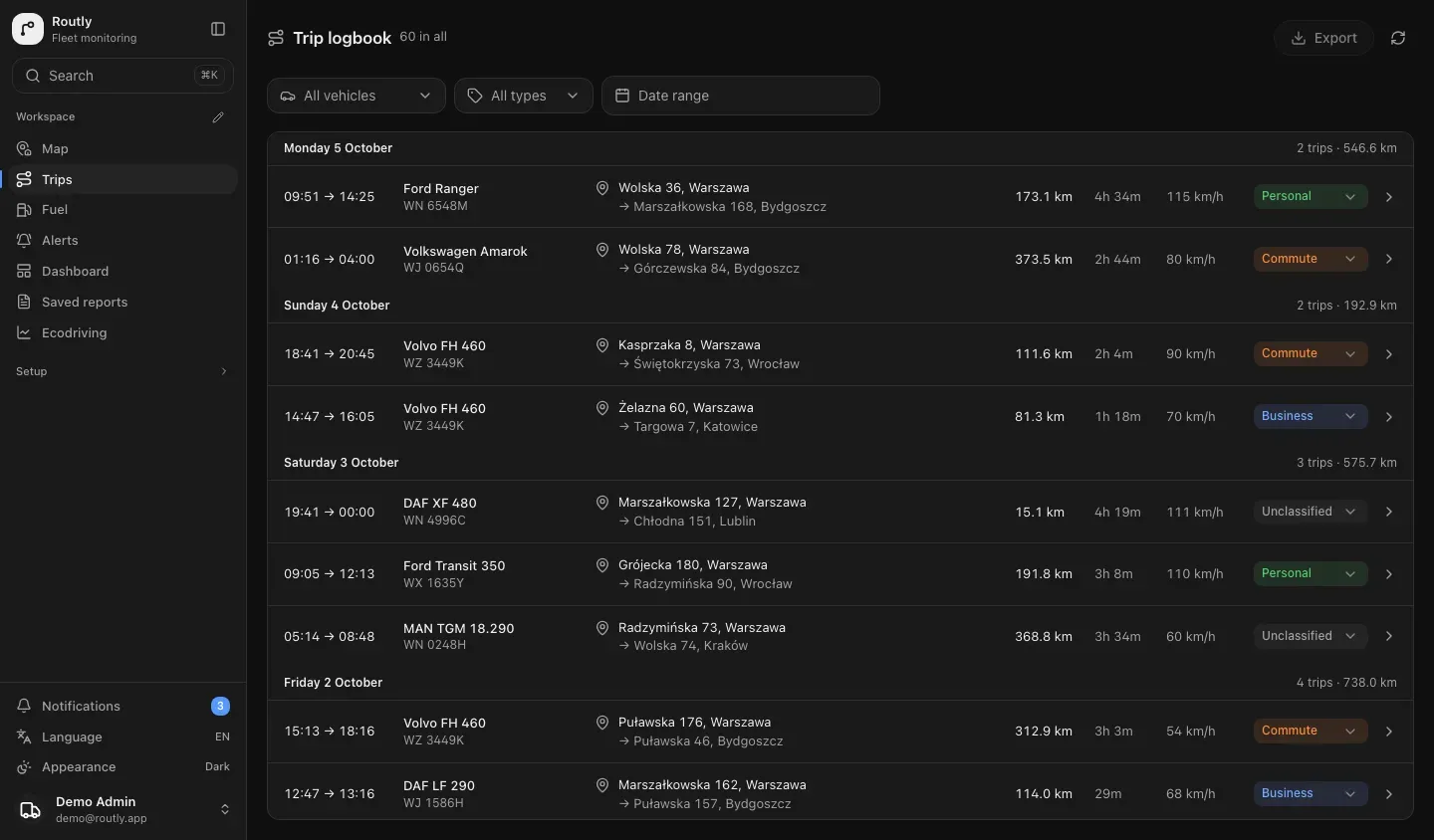
| Trip classification | — | Business, personal, commute |
| Driver behaviour scoring | — | Weighted, per component |
| Scheduled reports | Yes | CSV, Excel, PDF by email |
| Multi-tenant branding | White-label as a paid service | Built in; reports carry each customer’s logo |
Read the table top to bottom and the difference in intent shows. Fleetbase is built out horizontally, module by module, to cover more of a logistics operation. Routly is built down vertically into one thing: telemetry that a telematics business can sell. Where Fleetbase is plainly ahead — orders, routing, invoicing, and connectors to Geotab and Samsara that Routly does not have — the table says so.
What Fleetbase costs
Self-hosted, Fleetbase is free under the AGPL. Around that, its pricing page lists:
- Fleetbase Cloud at $29 a month plus $5 per driver or vehicle, with unlimited orders. API calls and webhooks past the first 100,000 a month are $0.25 per 100,000; an invoice paid through a payment gateway is $0.10.
- A self-hosted deployment package at $2,500, once: deployment, CI/CD, configuration, branding and go-live support.
- Support from $1,000 a month with a 72-hour response, up to $5,000 a month for a dedicated engineer.
So “no per-vehicle fees” holds for self-hosting. On their cloud, a 200-vehicle fleet is $29 + 200 × $5 = $1,029 a month. Whether that beats running it yourself is the arithmetic in the cost worksheet.
Routly has no cloud plan to set beside that. A fleet self-hosting for itself pays nothing under the AGPL, and the commercial licence is quoted per deployment.
When to choose Fleetbase
Plainly, because sending you to the wrong tool wastes your time and eventually our reputation:
- Your business is deliveries or field service, and orders, dispatch and routing are the core rather than an add-on.
- You want a modular platform you will extend across several logistics functions — warehousing, invoicing, a storefront.
- You need a driver-facing app for job execution, not just fleet visibility.
- Your vehicles already report to Geotab or Samsara, and you want dispatch on top of them.
When to choose Routly
- Your business is fleet operations or selling telematics, and the questions are where, what happened, what it cost and who drove.
- You already run Flespi or Traccar and want the positions turned into trips, fuel events and scores. Fleetbase’s connectors put devices on its map; working out what the positions mean is Routly’s whole job.
- You are a provider with customers to isolate, and you need per-customer report branding rather than one tenant per deployment.
- The features that decide it are fuel-loss detection, driver scoring and scheduled reporting.
- You are leaving Wialon and want a path that does not touch a tracker.
Other Fleetbase alternatives
Routly is not the only answer, and for half the people searching it is the wrong one. Sorted by the part of Fleetbase each one replaces:
Traccar — if you only need tracking
Traccar is Apache-2.0, Java, and decodes 200+ device protocols. It is a device gateway with a map, not a logistics suite: no orders, no dispatch. Many teams run it underneath something else, Routly included. Traccar against Routly.
CoopCycle — if you are a delivery co-operative
CoopCycle is a self-hosted platform for bike delivery: orders, dispatch, courier management, a storefront for local shops. The catch is the licence — Coopyleft, which reserves the software for co-operatives and social-economy organisations. A commercial courier cannot use it.
Onfleet — if you want dispatch without running anything
Onfleet is hosted delivery management, not open source, billed by completed tasks, from $619 a month. It replaces Fleet-Ops’ dispatch and driver app and nothing else, and there is no server to look after.
Routly — if your problem is vehicles, not orders
Everything above this section. For the self-hosted field side by side — Traccar, OpenGTS, Fleetbase, Wialon Local and Routly — see the five-way comparison.
Where they differ architecturally
Two decisions have consequences worth knowing about.
Ingest. Neither decodes trackers itself. Routly reads from Flespi, from Traccar, or from any gateway that can POST JSON — three paths, all in the repository. Fleetbase went the same way: Fleet-Ops pulls from telematics platforms through provider adapters. Neither competes with Traccar’s two hundred protocols, and adopting either means not re-pointing a single device. The difference is which platforms: Fleetbase reaches the big commercial ones, Routly reaches self-hosted Traccar and anything that speaks JSON.
Storage. Fleetbase writes every position and device event into its MySQL database and prunes them on a schedule — positions after 90 days and device events after 30 by default, adjustable per company. Routly derives trips and events at ingest and keeps them in Postgres, where nothing expires. Raw positions are the replaceable part: Postgres for a small fleet, or a separate ClickHouse at about nineteen bytes each, kept for 90 days. The track itself lasts about as long in both; what Routly keeps for good is what the track meant.
The licences are identical, which matters more than it sounds
Both are AGPL-3.0, so the same clause applies to both: modify it, offer it to others over a network, and you publish your modifications. If you intend to resell either one under your own name with your own integrations, read what AGPL means commercially before you build.
Both also sell a way out. Fleetbase’s Commercial License (FCL) and Routly’s commercial licence each remove the disclosure obligation. Compare what else comes with them — warranty, indemnity, support — because those are what a reselling business ends up needing on paper.
Frequently asked
Is Fleetbase free?
Self-hosted, yes, under the AGPL-3.0. Fleetbase Cloud is $29 a month plus $5 per driver or vehicle, and the optional self-hosted deployment package is $2,500 once.
Is Fleetbase open source?
Yes. The platform, Fleet-Ops and the Navigator driver app are public on GitHub under AGPL-3.0, with a commercial licence for anyone who cannot accept its terms.
Does Fleetbase work with GPS trackers?
Through a telematics platform rather than directly. It has adapters for Flespi, Geotab, Samsara, AFAQY and Safee, and Flespi in turn decodes most tracker hardware on the market.
Can I run both?
In principle yes — Fleetbase for orders, Routly for telemetry, with a shared Flespi account feeding positions to both. Whether two systems is better than one imperfect one is a judgement about your team, not about the software.
Which has the bigger community?
Fleetbase, by some distance: 4,166 GitHub stars when this was updated. Community size is a real factor when you are self-hosting, and a larger one means more answers to your questions. It is a legitimate reason to choose them.
Is this comparison biased?
We build one of them, so obviously. The way to discount for that is to check the claims: our side is all in a public demo with no account required, and theirs is linked to its source on every line above. Where we have said Fleetbase does something better, we mean it.
What if neither fits?
Then the honest answer is Traccar plus your own reporting, Onfleet if you want dispatch as a service, or a hosted platform if the cost worksheet says a subscription wins for your fleet size.