Telematics data is portable in the boring sense: it is rows, and rows come out as CSV. Video is not, and if you run Samsara cameras that is the part of the migration that has a clock on it.
Everything else in this post is ordinary migration work. Start with the cameras, because it is the piece nobody costs and the only piece that cannot be reconstructed afterwards.
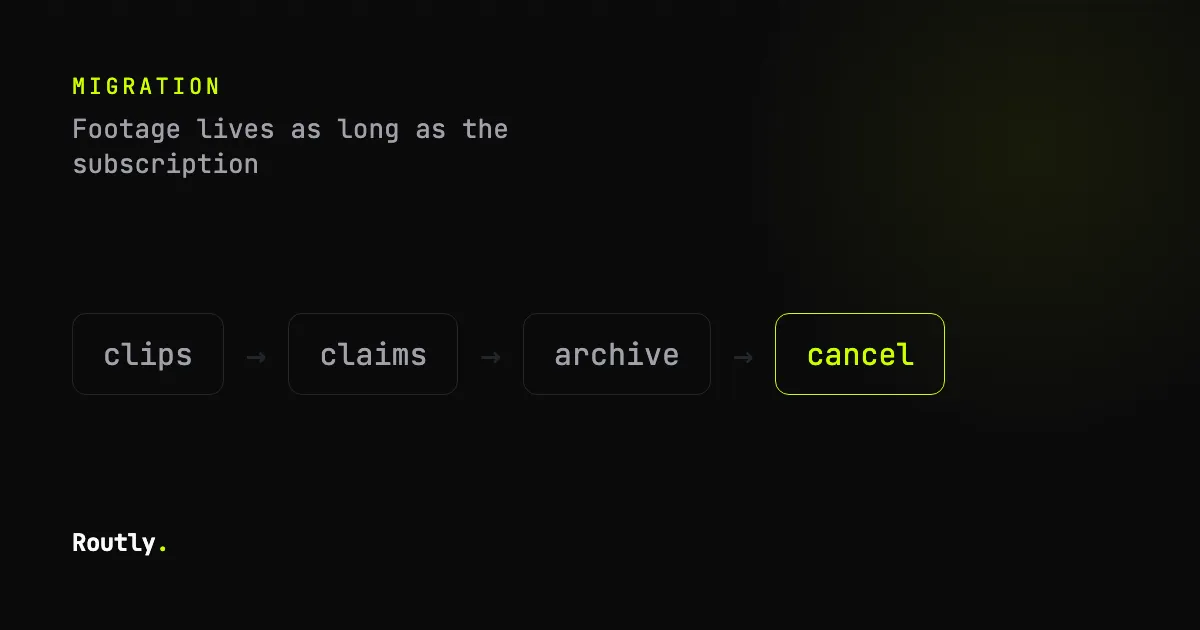
Footage lives as long as the subscription
Samsara’s default is to keep DVIR, HOS and dash-cam data for as long as you are a customer. Retention can be set to something shorter — 28, 30 or 45 days, or as long as four years — and changing it requires a written request from your account administrator to Samsara Support. EU customers get a different default: dash-cam data for six months.
Read “as long as you are a customer” the way a lawyer would. It is not a promise about how long footage exists; it is a statement about what ends when the contract does.
So before anything else, work out which clips you would be unable to explain losing:
Anything attached to an open claim or dispute. If a lawyer might ask for it, it comes out as a file now, into storage you control, with the incident date in the filename.
Anything that was used in driver coaching. If a driver was disciplined on the strength of a clip, that clip is part of an employment record in most jurisdictions, and the employment record outlives the software subscription.
The recent tail, whatever your retention was. Incidents surface late. A collision reported three weeks after the fact is normal, and after cancellation there is nothing to look at.
Video is also the slowest thing to extract. Retrieval is per-event rather than bulk, so a hundred clips is a hundred operations. Start it in week one of the project, not in the last week of the contract.
Then the ordinary part
Samsara exports two ways: the API, or CSV straight from the dashboard, covering ELD, safety and the rest.
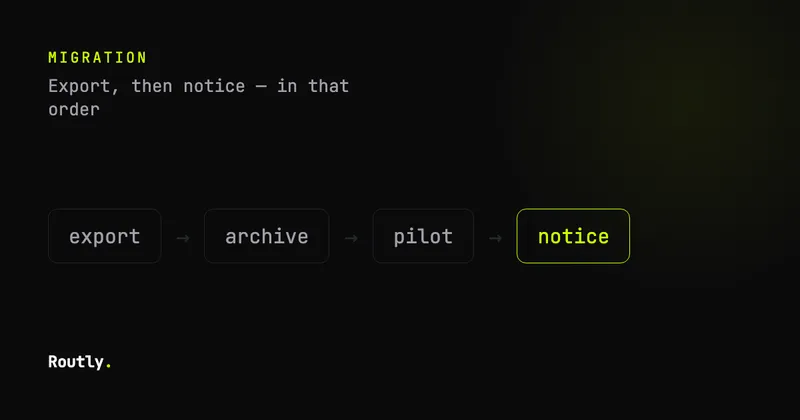
If you are under the US ELD mandate, the same rule applies here as anywhere: six months of records of duty status under 49 CFR 395.8(k)(1), and that obligation belongs to the carrier rather than the vendor. Pull it before you send notice, then open a file and check it is readable. The Motive post walks through the compliance dates in detail — the seven-day rolling record on cutover day, the 48-hour production standard across two systems — and none of it changes because the logo does.
Beyond the regulated minimum, the list is short and worth writing down: GPS history, because every route dispute lives there; safety events with their coaching notes, because the note is the part that means anything; and the configuration nobody remembers building — geofences, alert thresholds, driver groups, working hours.
The EU Data Act gives you a deadline
This is the part most fleets do not know they have.
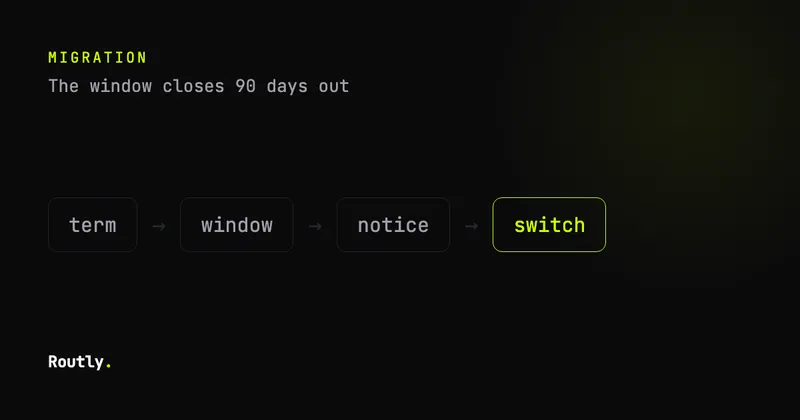
Under EU Regulation 2023/2854, the Data Act, a customer can start a switching process by giving Samsara at least two months’ written notice, after which there is a further period of at least thirty calendar days for data portability. Samsara documents this in its own data protection addendum.
If you are an EU customer, that converts the whole conversation. Portability stops being something you negotiate and becomes something with a date attached — and the thirty days sit after the notice period, which means the exit is roughly a quarter long and should be planned as one.
If you are not an EU customer, you have the contract and nothing else, which is a reason to read the termination clause before the first sales call with anybody new.
The hardware question, asked properly
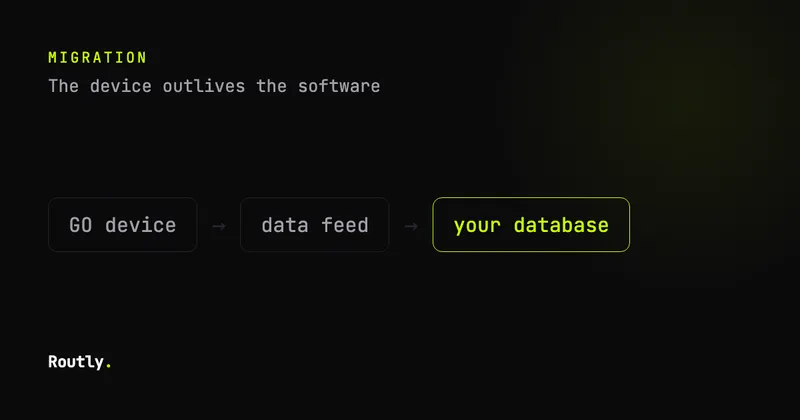
Samsara’s gateways and cameras are Samsara’s. Plan on replacing them, and ask every incoming vendor the same question you should have asked when you bought: which devices already in my fleet do you support?
Platforms built around open protocols — Teltonika, Queclink, Ruptela, Concox — will name the models they decode. Platforms built around their own gateway will change the subject, and the quote in front of you is a second capital purchase whether or not it is itemised as one.
Cameras deserve their own line in that conversation. AI dash cams are the most expensive hardware in a modern fleet and the most vendor-specific, and “we integrate with cameras” covers everything from full video retrieval to a link that opens somebody else’s portal. Ask which camera models, what the retention is, where the footage is stored, and who pays for the storage.
It is not universal. Geotab is the large vendor whose hardware is not the hostage — its devices can feed software of your choosing, which removes this section from that migration entirely. And whatever the hardware says, check the renewal clause before you plan anything: an auto-renewing term decides whether you are running a migration or paying for another year of the thing you are leaving.
What never comes across
Safety scores. Every platform weighs harsh events differently. Scores restart, and the driver who was your safest for two years will notice on day one. Tell people before, not after.
The coaching history. Sessions, acknowledgements, the record of who was shown what and when. Some of this may matter for employment reasons; assume the software will not carry it and export what does.
Anything a model learned about your fleet. Detection tuned to your routes, your yards, your camera angles. It starts cold, and the first weeks produce more false positives than your dispatchers are used to. Budget attention for it rather than being surprised.
Frequently asked
Can we keep the cameras and change only the telematics?
Sometimes, and it is worth pricing. Running cameras on one contract and telematics on another is more integration work and less capital expenditure. It also splits your data across two vendors, which is fine until an incident needs both halves in the same timeline.
How long does the export actually take?
Rows are quick. Video is not — assume weeks rather than days, because retrieval is per-event, and assume somebody has to sit with it rather than run a script.
We are mid-contract. Is there any point starting now?
Yes. The export is the part that has to happen regardless, and it is the part that gets compressed if you begin it after giving notice. Nothing about pulling your own data early commits you to leaving.
Where this leaves us
Routly is not a registered ELD and does not do video. If your fleet is under the US mandate you need a certified device from the FMCSA list, and if cameras are core to your safety programme you need a camera vendor. Neither of those is us, and a post that pretended otherwise would waste your afternoon.
What is here is the layer underneath both: telemetry, trips, fuel, geofences and reports, running on hardware you already own, with the position history in a database you control rather than in a subscription. For a lot of fleets that is the part that was never worth renting — and running it beside a certified ELD is a common enough arrangement that it has stopped being unusual.
The live demo runs on real telemetry with no sign-up. If you are only here for the export checklist, take it and go: it is the same list whoever you end up with, and doing it in the right order is worth more than the choice of destination.