Every other migration post is mostly about data. This one is mostly about a date, because with Verizon Connect the technical work is ordinary and the thing that catches fleets is the calendar.
The window closes before you notice it is open
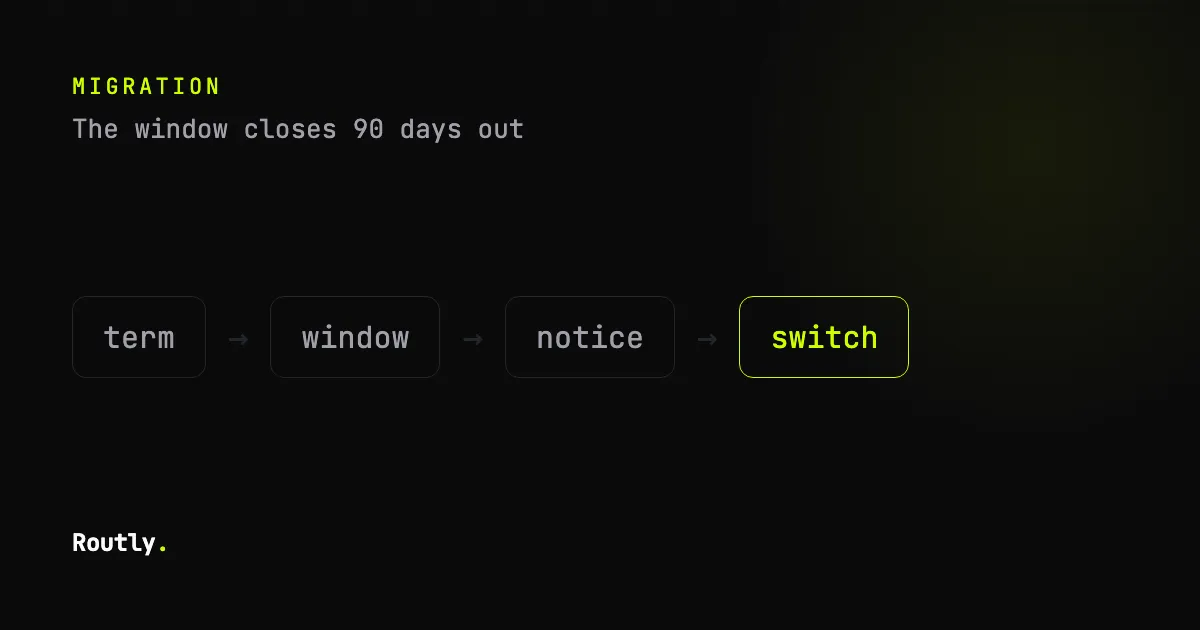
Verizon Connect contracts renew automatically, and the notice of non-renewal has to arrive inside a window that closes 60 to 90 days before the term ends. The subscription agreement puts it plainly: absent written notice by the date and method on the order form, the term renews.
Which produces a specific, common and entirely avoidable failure. A fleet decides in month ten of a twelve-month term to look at alternatives, spends six weeks on demos, and discovers on signing day that the renewal already happened — sometimes for another three years. The Better Business Bureau’s complaint file has more than a hundred unresolved entries, and this pattern recurs through them: a customer who moved to cancel and was told the term had already rolled.
So the first action is not an export and not a demo. It is finding the order form, reading the renewal clause, and putting two dates in a shared calendar with owners’ names on them:
- The date the notice window opens.
- The date it closes — and treat that as the deadline, because the requirement is written notice by a specified method, and an email to a sales contact may not be it.
Do that before you evaluate anybody. A comparison that runs past the window costs you a full term.
Send the notice, then take your time
There is a temptation to delay the notice until you are certain of the replacement. With an auto-renewing contract that gets it backwards.
Notice of non-renewal ends the automatic roll; it does not switch anything off tomorrow. You keep the service to the end of the term, and you keep it while you evaluate, pilot and cut over. Miss the window and the decision is made for you for another year — or three.
Check two things in the order form before writing: the method the notice must take, and whether anything else is bundled into the same term. Hardware leases, camera add-ons and separate order lines can carry their own dates.
The export, which is the ordinary part
Verizon Connect does not publish a data-export procedure in the same way its peers do, and its documentation does not describe one publicly. That is itself worth knowing: ask for the export path in writing, early, while you are still a paying customer with an account manager who answers.
Ask specifically:
- What formats are available, and by what mechanism — self-serve, API, or a support request.
- How far back the exportable history goes.
- How long the account remains reachable after the term ends.
- Whether there is a fee.
What to take is the same list as anywhere. If you are under the US ELD mandate, six months of records of duty status under 49 CFR 395.8(k)(1) — the carrier’s obligation, not the vendor’s, so it survives the account closing. Then GPS history, because that is what every route dispute needs; trips and stops; maintenance and inspection records; and the configuration nobody remembers building — geofences, alerts, groups, scheduled reports.
The Motive post covers the compliance mechanics in full: the seven-day rolling record on cutover day, the 48-hour production standard when an audit spans both systems, the 60 days you get if a device is revoked. Those rules are federal, so they do not change with the vendor.
Hardware, and the question worth asking
Verizon Connect’s units are theirs, and the working assumption is that leaving means replacing them.
Which makes this the moment to ask every candidate the question that decides the biggest number in your budget: which devices already in my fleet do you support? Platforms built on open protocols will list the models they decode — Teltonika, Queclink, Ruptela, Concox. Platforms built on their own hardware are quoting you a second capital purchase, and the quote may not say so.
Then count the labour honestly, because it is the part that slips: fifteen minutes to fit a device, half a day to get the vehicle to the fitter, once per vehicle, on a day it was supposed to be earning.
How big that bill is depends entirely on who you are leaving. Samsara’s gateways and cameras are Samsara’s; Geotab’s are not, and its devices can report into software of your choosing, which is the difference between a capital purchase and an afternoon of configuration.
A sensible order
- Find the order form. Diary both ends of the notice window. Today, before anything else.
- Ask for the export path in writing. While your account manager still returns calls.
- Export, and open the files. An unreadable download is a normal outcome and you want to find it early.
- Send the notice inside the window. It stops the roll; it does not stop the service.
- Pilot five vehicles on the replacement, running in parallel, comparing the numbers people argue about.
- Cut over on a quiet week — not your peak, not before a compliance review, not the Friday before a long weekend.
The pilot and the cutover are the flexible parts. The first step is not.
Frequently asked
We think we already auto-renewed. Anything to do?
Read the order form for the current term’s end date and diary the next window immediately, then ask — in writing — what the early-termination position is. Even if the answer is unwelcome, you now have a date to plan to instead of a vague intention.
Can we run both systems for a while?
Yes, and you should. That is what the remaining months of a term you have already given notice on are useful for.
Is the export worth doing if we end up staying?
Yes. Six months of RODS is your obligation regardless, the GPS history is the thing you cannot rebuild, and neither depends on the outcome of the vendor conversation.
Where this leaves us
If you are under the ELD mandate you need a certified device from the FMCSA list, and Routly is not one. That is the honest answer, and it is the same one our cost comparison gives: when the deciding feature is compliance in a jurisdiction, buy the thing that has it.
What we do is the layer underneath — telemetry, trips, fuel, geofences and reports — on hardware you own, with position history in a database you control rather than in a subscription that renews itself. Self-hosting is AGPL and free; there is no term and nothing to give notice on, which after a contract like this one is either the main attraction or beside the point.
The live demo takes no sign-up. And if you take only one thing from this page, make it the calendar entry — that one is worth money whoever you choose.